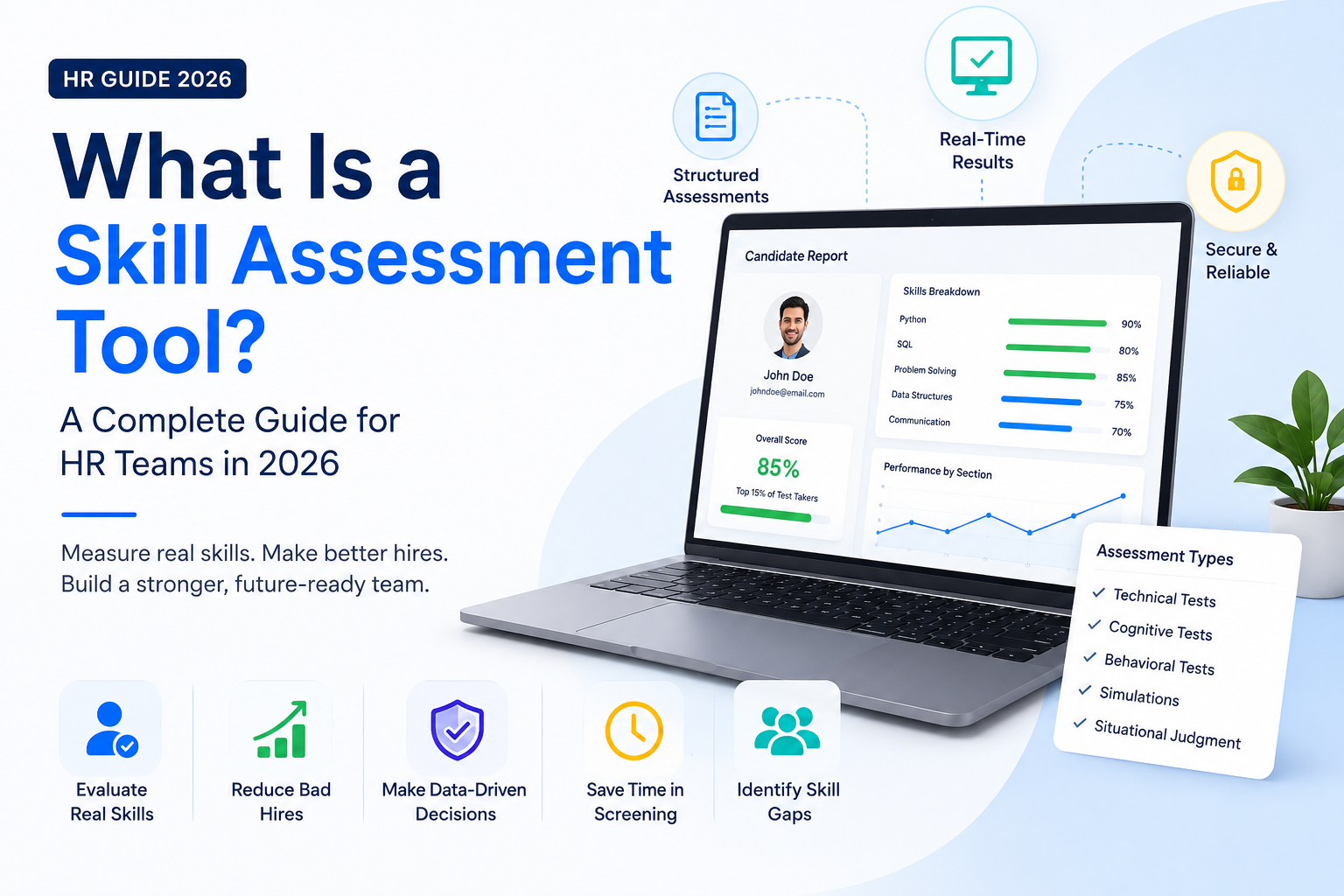
A skill assessment tool is software that measures a candidate’s or employee’s actual ability to do a task, through tests, scenarios, or scored exercises, instead of relying on a resume or an interviewer’s gut call. HR teams use it to build a shortlist they can trust, cut down on bad hires, and back people’s decisions with evidence instead of an impression.
If you’ve ever hired someone off a strong interview only to find out three months later they couldn’t actually do the job, you already understand the problem this category exists to solve. This guide covers what these tools are, how they work, what to look for, and where most HR teams go wrong when choosing one.
What Is a Skill Assessment Tool?
A skill assessment tool is a platform that evaluates a person’s technical, cognitive, or behavioral ability through structured tests rather than self-reported claims. Instead of a resume line that says “strong in Excel,” the candidate demonstrates it, through a timed task, a scenario-based question, or a graded exercise.
These tools typically get used at three points:
- Pre-hire: screening applicants before an interview
- Post-hire: checking what a new employee actually knows on day one
- Ongoing: tracking skill gaps across a team over time
The output is usually a score, a percentile against other candidates, or a skills report a hiring manager can act on directly, rather than a resume they have to interpret.
Did you know? Resumes and unstructured interviews are widely considered two of the weaker predictors of on-the-job performance compared to structured, job-relevant testing. That gap between what someone claims and what they can prove is exactly what these tools are built to close.
Why It Matters for HR Teams in 2026
Three shifts have pushed skill assessment from “nice to have” to standard practice:
Hiring volume outpaced manual screening. A single job posting can pull in hundreds of applications. No recruiter can manually check claimed skills at that scale, a structured assessment filters the pool before anyone picks up the phone.
Skills-first hiring replaced degree-first hiring. More companies are hiring for demonstrated ability over pedigree, and that only works if there’s a reliable way to measure ability in the first place.
Remote and hybrid work removed in-person cues. When you can’t watch someone work at the next desk, a structured, scored assessment becomes the most objective signal available.
For HR teams in India specifically, this matters even more. With high applicant-to-role ratios across most white-collar and campus hiring, a skill assessment tool isn’t just about fairness, it’s what makes screening operationally possible at that volume.
Types of Skill Assessment Tools
Not every assessment measures the same thing. Most platforms combine two or more of the following:
| Type | What It Measures | Common Use Case |
|---|---|---|
| Technical skill tests | Coding, tool proficiency, domain knowledge | Hiring developers, analysts, technical roles |
| Cognitive ability tests | Problem-solving, logical reasoning | Roles needing fast learning and judgment |
| Personality/behavioral assessments | Work style, communication, team fit | Team-fit and leadership hiring |
| Situational judgment tests | Decision-making in job-relevant scenarios | Customer-facing and managerial roles |
| Simulations | Real task performance in a mock environment | Sales, support, operations roles |
A well-built platform lets you mix and match these based on the role, rather than pushing every candidate through the same generic test.
Key Features to Look For
These are the features that separate a genuinely useful platform from a glorified quiz builder:
- Job-relevant test creation: building assessments from your own job description, not just a generic template library
- Proctoring controls: tab-switch detection, ID verification, plagiarism checks for technical tests
- Detailed, comparable scoring: percentile ranking and a skill-by-skill breakdown, not just a pass/fail flag
- ATS integration: results flow into your existing hiring workflow instead of living in a separate dashboard
- Consistent, standardized scoring: the same criteria applied to every candidate
- Scalability: running the same assessment across hundreds of candidates without extra admin work
That ATS integration point is worth sitting with. A lot of HR teams end up with an assessment tool on one side and a candidate pipeline on the other, with someone manually copying results across. The stronger setup is an assessment platform (like Paraakh) that plugs directly into your ATS and hiring workflow (like CheckdIn), so a candidate’s score, claimed-versus-proven breakdown, and interview brief travel with them through the pipeline instead of sitting in a separate report someone has to go find.
How a Skill Assessment Tool Fits Into Your Hiring Process
- Define the skill, not the job title. Start from what the role actually requires day to day, not a generic template for “Sales Executive” or “Backend Developer.”
- Send the assessment before the interview. Screening on demonstrated skill first means every interview slot goes to someone who’s already cleared the bar.
- Review scored, ranked results. Sort by skill percentile instead of manually reading every resume.
- Use the report in the interview. A good assessment report gives interviewers specific follow-up questions based on where a candidate scored high or low.
- Track post-hire performance against assessment scores. Over time, this tells you whether the assessment is actually predictive, and lets you refine it.
Skill Assessment Tools vs. Traditional Interviews
| Traditional Interview Only | Skill Assessment Tool + Interview | |
|---|---|---|
| Basis for decision | Impression, resume claims | Demonstrated, scored performance |
| Scalability | Limited by interviewer time | Can screen hundreds simultaneously |
| Bias risk | Higher subjective judgment | Lower standardized scoring |
| Time to shortlist | Days to weeks | Hours to a day |
| Evidence for later hiring decisions | Interview notes | Score + candidate report |
This isn’t either/or. The strongest hiring processes use assessment tools to narrow the pool objectively, then use the interview for what a test genuinely can’t measure: communication, motivation, and fit.
Common Mistakes HR Teams Make
Buying a huge test library and never customizing it. Off-the-shelf generic tests often don’t map to what your specific role actually needs.
Making the assessment too long. Long assessments increase candidate drop-off, especially among passive candidates who aren’t desperate for the role.
Ignoring the candidate experience. A clunky, buggy testing platform reflects badly on your employer brand before a candidate has even reached an interview.
Not checking the test against real performance. If you never verify that high scorers actually perform better on the job, the assessment is adding a step, not adding signal.
Treating it as a one-time hiring gate. Teams that only use assessments for pre-hire screening are leaving value on the table, the same structured-testing approach is useful well beyond the initial hire.
Expert Insight: Across hiring and screening use cases, one pattern shows up consistently: teams that treat skill assessment as a single hiring gate get far less value than teams that build it into a repeatable part of how they evaluate candidates at every stage. The tool matters less than how consistently it gets used.
How Paraakh Approaches Skill Assessment
Paraakh is built around one core idea: the job description you already have contains most of what’s needed to build a relevant assessment. Instead of picking from a generic template library, Paraakh builds the test directly from your JD, so it reflects the actual role rather than a template written for a different company.
Alongside that, Paraakh compares what a candidate claims against what they demonstrate, and hands interviewers a candidate brief instead of a blank resume, so the second and third stages of hiring aren’t spent re-checking things the assessment already answered.
Many HR teams eventually want the same kind of structured testing for onboarding checks, internal skill-gap tracking, or training and compliance use cases, not just pre-hire screening. That’s a natural direction for this category, and if you’re evaluating platforms with that broader use in mind, it’s worth asking any vendor, including us, exactly which of those are live today versus on the roadmap.
Frequently Asked Questions
What is a skill assessment tool used for? It’s used to measure a candidate’s or employee’s actual ability to perform job-relevant tasks, most commonly during hiring, as a way to screen and shortlist before the interview stage.
Are skill assessment tools accurate? Well-designed, job-relevant assessments tend to be more predictive of on-the-job performance than resumes or unstructured interviews alone, because they measure demonstrated ability rather than self-reported experience.
What’s the difference between a skill assessment tool and a personality test? A skill assessment tool measures what someone can actually do, coding ability, analytical reasoning, task execution. A personality test measures behavioral tendencies and work style. Strong hiring processes often use both, for different purposes.
How long should a skill assessment take? Most effective candidate-facing assessments run 20–45 minutes. Longer tests increase drop-off, especially among passive candidates who have other offers in play.
Can a skill assessment tool prevent cheating? Modern platforms include proctoring features like tab-switch detection, plagiarism checks, and identity verification, particularly important for remote and technical assessments.
How is a skill assessment tool different from an ATS? An applicant tracking system, like CheckdIn, manages the hiring workflow and candidate pipeline. A skill assessment tool, like Paraakh, evaluates candidate ability. They’re complementary, and work best connected: an AI-powered ATS with integrated candidate assessment gives you one path from application to verified shortlist, instead of a resume pile on one side and test results on the other.