First submission wins
Ownership attaches at duplicate-check time, to whoever got there first. There is no queue to appeal to and no discretion to lobby.

Every company hiring through more than one partner has this argument eventually, and it is always about money. Here is exactly what happens, day by day.
Ownership attaches at duplicate-check time, to whoever got there first. The server stamps the time, not Acme, because submission order decides money.
Owns · until 12 OctTold plainly: owned by Acme Staffing until 12 October. Not a silent rejection. They decide today whether to spend more hours here.
Second · sees the reasonNo re-import, bulk action, re-score or admin shortcut can reassign it inside the window. Enforced in the core, so bypassing the interface does not bypass the rule.
Window holdsJoining is what the money waits for. An acceptance that never became a joining raises nothing, because a 90-day notice and an offer drop are the normal case here.
PlacementCalculated from who owned the candidate, at the version of Acme's terms in force then. Renegotiating next quarter does not change this placement.
Fee to AcmeYou produce the submission-order history: who submitted, when by the server clock, who won, until when. A log in order rather than a field that was overwritten.
Evidence, both ways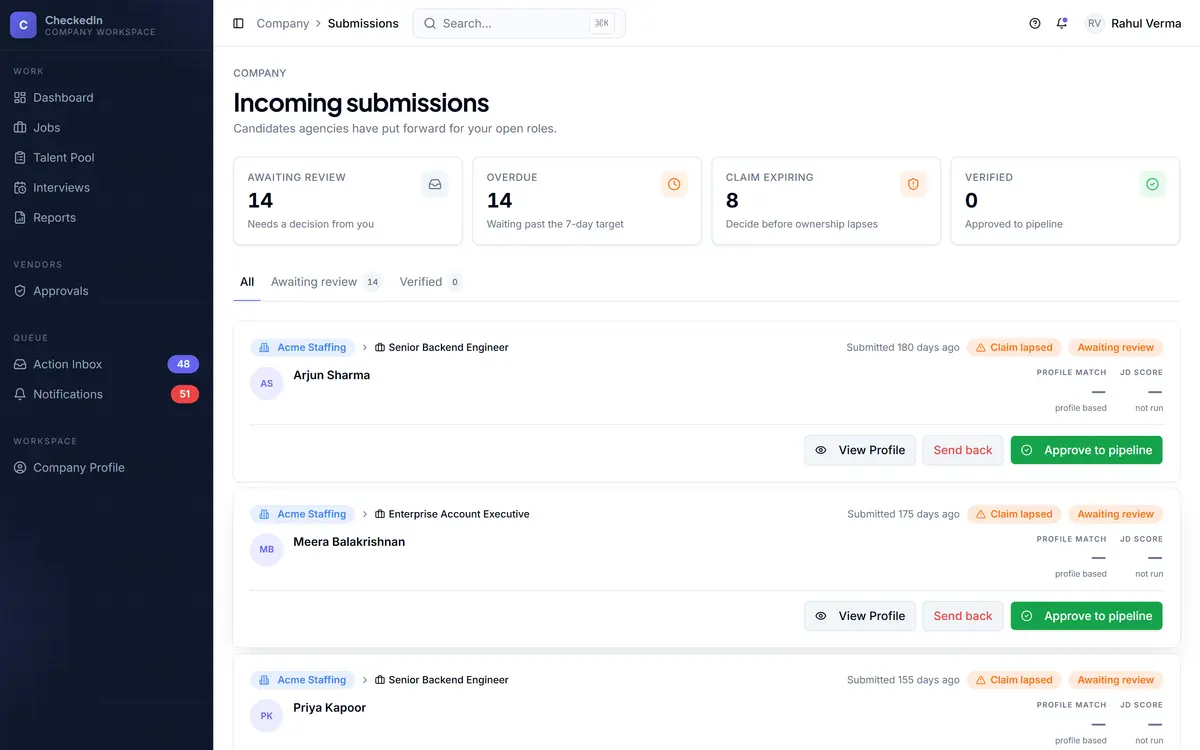
Candidate ownership is which agency holds the right to a fee on a candidate, decided once at the first submission and sticky for the window in your fee agreement. Ninety days is common, but it is whatever the MOU says. This is not a Right to Represent: an RTR is a candidate-signed US document authorising one agency to present them to one named client. Ownership here is the client's own attribution record, which is a different instrument doing a different job.
Ownership attaches at duplicate-check time, to whoever got there first. There is no queue to appeal to and no discretion to lobby.
Not the submitter. Agencies have an obvious financial reason to want to control that timestamp, so they do not get to.
No re-import, no bulk action, no re-scoring, no admin shortcut. A transfer after the window expires is explicit and recorded, never silent.
If the candidate was already in your database from a non-agency source they are flagged in-house, and no agency gets ownership or a fee.
The invoice uses the version of the terms in force when the placement happened. Renegotiating next quarter does not retroactively change what you owe on this one.
Ownership is not a value that gets overwritten as the situation changes. It is an append-only record of what happened, in order, which is exactly what makes it usable in a dispute.
Ranked by how much it hurts. Two of these CheckedIn addresses directly, one it helps with, one it does not solve.
You sourced, screened and submitted. Someone got there three days earlier. Not a thin margin, a total loss on work already paid for.
They cost recruiter hours and quietly downgrade your standing on the panel, which costs you next quarter's mandates. Score before you submit and the ratio moves.
No joining, no invoice, after six to ten weeks of work. CheckedIn does not prevent this. One chase task at five days, one confirm-joined task at the start date. Prompting, not retention.
Clients push 8.33% down, or split a role across eight agencies so nobody invests. A per-client scorecard changes that conversation: submissions, pass rate, submission-to-placement, TAT.
Which is why submission quality is not a soft metric. Every submission that never reaches an interview is money already spent with nothing against it.
Loaded recruiter cost divided by submissions in the period.
Cost per submittal divided by your submission-to-interview ratio. This is the number that actually moves.
Same recruiter, same salary, no new headcount. The only thing that changed is which eight profiles went out instead of which thirty.
Illustrative figures. Substitute your own loaded cost and ratio.
We will not tell an agency we protect them: the client configures the window and the client's system holds the record. What is true is more useful than that.
It is a two-minute demo and it is the one thing an email thread can never do. Bring the messiest duplicate argument you have had this year.