
CheckedIn · for companies

Every hiring decision, with the reasoning still attached.

For TA teams filling roles through more than one recruitment partner. A shortlist you can defend requirement by requirement, gates that hold, and one invoice to the partner who genuinely submitted first.

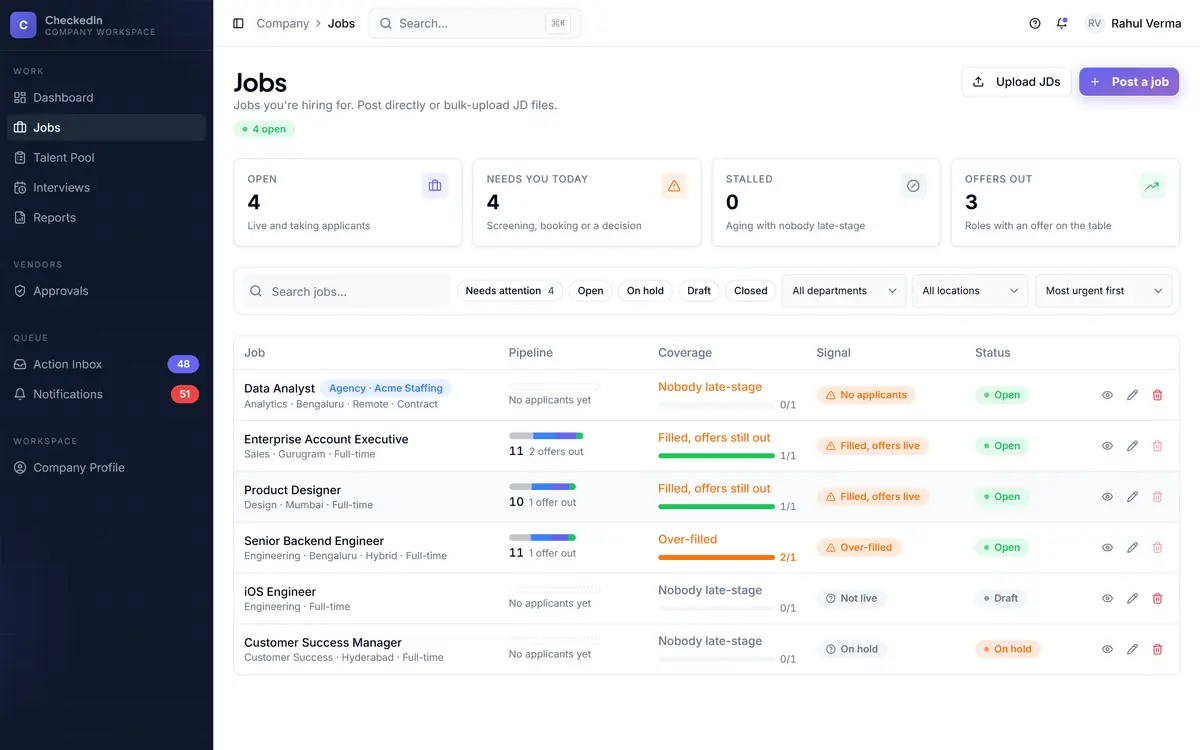
company · open roles A VERDICT PER ROW
The open roles list, each row carrying a coverage and signal verdict

Real screen. Rows rank by consequence, so an over-filled role is flagged as urgently as one with no applicants.

The week, in the order it happens

Seven steps. What is manual today, and what changes.

Nothing reordered to flatter the product, including the two places it deliberately does not help.

01

The requisition

Today“Strong Java, must have led a team.” Two weeks later nobody agrees what strong meant.

With CheckedInPaste the JD, edit the must-haves it produces, approve, publish.

5+ years stays 5Rs. 18,00,000 → ₹18 lakhsign-off if you want it
02

CVs arrive

TodayProfiles in three inboxes, a WhatsApp thread and a shared drive. Duplicates found by accident.

With CheckedInFour doors, one funnel. Parsed, deduplicated and ranked in about two minutes.

Drive · email · sheet · careerssame file twice does nothing3 dedup keys
03

The shortlist

TodayYou send five. The manager rejects all five and cannot say why, so the next five are wrong too.

With CheckedInRanked against the spec you approved, with a row per requirement you can point at.

7 factorsrejection needs a reasonidentical order tomorrow
04

The assessment gate

TodaySomeone reaches the final round before anyone finds out they cannot do the thing.

With CheckedInThe measured result replaces the CV's claim. Below the bar, they are held there.

recruiter edits before sendingpass mark pinned per runenforced in the core
05

Interviews

TodayFeedback arrives three days late, in Slack, from someone who was not on the panel.

With CheckedInSchedule over email as you do today and copy in an address. It reads the thread.

no calendar engine, on purposepanel-only feedbacktask due +1 hour
06

The offer

TodayAn offer went out above band because the approval was an email somebody forgot to send.

With CheckedInDraft, approve, send, track. Two guards on the amount, one chase task if it goes quiet.

ceiling: approval above itfloor: no ₹0 offerchase at 5 days, once

The ceiling defaults to effectively unlimited, so nothing is gated by value until somebody sets it. Set it in week one.

07

Joining, and the fee

TodayTwo agencies claim the same placement and finance settles it by reading an email thread.

With CheckedInThe payable reads who owned the candidate, at the terms in force then.

append-only ownershipversioned fee termssubmission-order history
The buyer nobody builds for

Whoever approves the agency invoice has never had a document to point at.

Recruitment fees get argued about because the evidence lives in email.

You pay once, to the right partner

Derived from the ownership record, not from whoever raised the paperwork first. Someone already in your database is flagged in-house, and no fee arises.

A disputed fee has a document behind it

Who submitted, when by the server clock, who won, until when. Append-only, so it is a history rather than a field somebody updated.

Terms cannot change retroactively

Versioned per partner. A renegotiation next quarter does not alter what is owed on a placement made under the old agreement.

One honest gap: there is no role called Finance in the permission system yet, so invoice approval currently sits with an administrator. If a separate finance seat matters to you, ask about it in the demo rather than assuming it.

Reporting

A dashboard number that disagrees with its own list is worse than no number.

Counters drift. Every figure here is folded from the history at the moment you ask, so a tile always equals the list it links to, and a new metric next quarter is a replay rather than a migration.

41 built-in reports

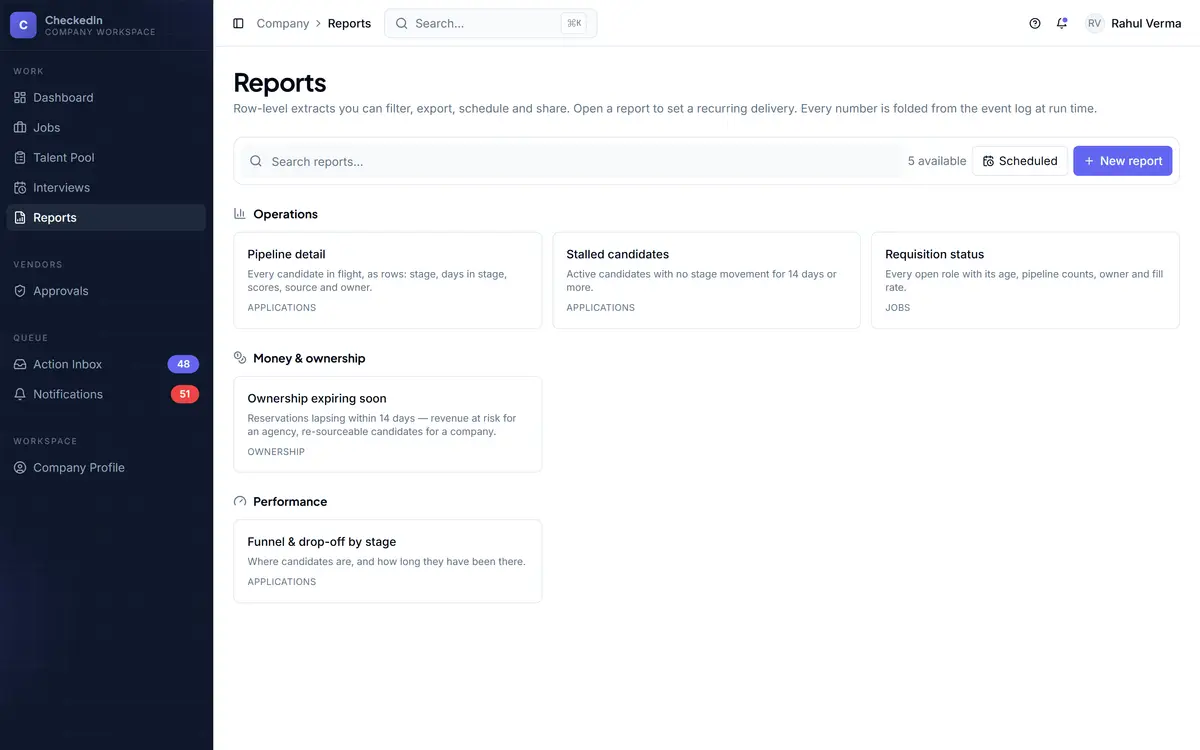
Operations, performance, money and ownership, governance, executive. Plus a builder, scheduled delivery, and links you can share with someone who has no account.

Endpoints, always stated

Time-to-fill here is requisition opened to joined. Not opened to offer accepted, and not time-to-hire.

company · reports 41 REPORTS
The report library grouped by the decision each report serves
Configuration, not a change request

Add a stage on a Tuesday. Nobody mid-pipeline notices.

Stages, rounds, scorecards, screening questions, approval chains, notification rules, fee terms and scoring weights. All editable without a developer.

Editing publishes a new version

Nothing is overwritten. Roles already in flight stay pinned to the version they started under, which is what makes people willing to change the process at all.

One form builder behind everything you ask people

Screening, scorecards, the apply form and joining forms on one engine: six answer types, branching, self-scoring with banded verdicts, and reusable question banks.

One exception: screening questions are not version-pinned per application, so editing them mid-role changes the rules for candidates already in flight.

Before procurement asks

The gaps, from us rather than from a reference call.

No single sign-on yet

No SAML, OIDC or SCIM. Usually a procurement condition above ~200 employees, so raise it early.

No SOC 2 or ISO 27001 certificate

Neither exists. What does is on Security & Trust, and it is specific rather than reassuring.

No custom fields on candidate records

Ask anything through a form and score it. You cannot yet add a field to the candidate record itself.

No job-board posting or careers-site branding

A careers page and apply form, but no distribution to Naukri, LinkedIn or Indeed, and no theming.

No calendar or availability engine

A stated design decision. It reads the scheduling thread you already send and captures the time, the panel and the link.

No offer e-signature

Templated offer, a response page, and a recorded decision. Not a signature platform.

No diversity reporting on declared demographics

Representation is reported by classification tags rather than by self-identified demographic data, deliberately.

Background jobs are not optional

Three of four intake channels, every task, notification and email need the worker process. If it stops, screens still load and nothing new arrives.

Erasure

Erase the person. Keep the record.

Their name, email, phone and CV become permanently unreadable, because the decryption key is destroyed rather than a row marked deleted.

The history still holds

The funnel count does not move, the agency's fee is still defensible, and the ownership record still names who won.

They do not come back as a ghost

The duplicate-check hash survives erasure, so re-ingesting the same CV later does not resurrect a record.

Retention sweeps ask first

Data reaching its retention limit raises a review task rather than deleting quietly.

An auditor can be handed the audit log, because it carries identifiers and never personal data.

That is a design constraint, not a policy promise.
For companies

Bring one open role and the CVs you already have.

We will publish the requisition, run your candidates through it, and hand you the ranked list with the receipt behind each score. Then you tell us which row is wrong.

Book a demo