The Real Problem Isn’t Finding Candidates
Most startups don’t struggle to find candidates. They struggle to tell, quickly and with any confidence, which of those candidates can actually do the job.
A ten-person company doesn’t have a recruiter reading three hundred resumes line by line. It has a founder, or one overstretched HR hire, trying to fill five open roles while also running payroll, onboarding, and half of ops. There isn’t time to verify anything properly, so most teams end up guessing off a resume and hoping the interview catches what the resume missed.
That’s the gap AI-led screening has started to close, not by replacing judgment, but by taking on the parts of hiring that never needed a human in the first place: reading applications at volume, checking claimed skills against something more concrete, and narrowing the field down to the handful of people actually worth a founder’s time.
Did you know? Teams running structured pre-interview screening typically cut their time-to-shortlist from weeks to days, simply because interviewers stop spending the first 45 minutes of every call re-discovering basic skill gaps a test could have caught.
Why Startup Hiring Breaks Down at Speed
Traditional hiring was built for a world where one job posting pulled fifty applications and a recruiter had a week to work through them. That math doesn’t hold anymore. A single decent listing on LinkedIn or Naukri can pull in hundreds of applications within days, and most early-stage teams don’t have the headcount to read them properly.
That leaves two failure modes, and neither is good:
- The team spends weeks manually screening and loses strong candidates to faster-moving competitors.
- The team skims résumés in thirty seconds each and ends up hiring on keyword-matching instead of actual ability.
Either way, the hire is a guess dressed up as a decision.
What’s Actually Working in 2026
Screening technology has moved past the hype cycle. Here’s what’s genuinely earning its place in a hiring process right now, described the way an HR lead would explain it, not the way an engineer would:
Faster, more relevant screening. Applications get matched against a role’s actual requirements rather than sorted by keyword density, so the people who reach a human reviewer are the ones worth reviewing.
Assessments built around the role, not a generic bank of questions. Instead of pulling from a stock test library, screening tools can generate role-specific evaluations directly from a job description, so the test reflects what the job needs rather than a template written for a different company entirely.
Structured first-round interviews. Adaptive screening interviews can ask sensible follow-up questions and produce a clean transcript, useful as a first filter before a real interview, not a substitute for one.
Integrity checks that scale. For technical and remote hiring, flagging suspicious behavior, plagiarism, or impersonation at the volume startups now deal with just isn’t something a human can do manually anymore.
What none of this does, and won’t do reliably any time soon, is make the final call, judge genuine culture fit, or replace an actual conversation between a founder and a candidate about why they want the job. Screening is a filter. It was never meant to be the judge.
Expert Insight: Working with growing teams on their hiring stack, the pattern that shows up again and again is that the companies getting the most value aren’t the ones automating the most steps. They’re the ones automating the right step: the one where a recruiter or interviewer would otherwise be re-verifying something that’s already been proven.
Where the Value Really Shows Up
Not every part of hiring benefits equally. Based on how growing teams are actually using screening tools in 2026, the highest-leverage spots are:
- Pre-interview skill screening, narrowing hundreds of applicants down to a shortlist of ten to twenty based on demonstrated ability, not résumé claims.
- Technical hiring at any scale: objective, instant grading on coding and technical evaluations, something no founder has time to do by hand.
- First-round interview automation, covering baseline screening questions upfront, so founder time goes to candidates who’ve already cleared the bar.
- More consistent early screening, applying the same standard to every candidate, which is a real improvement over résumé review, where unconscious bias creeps in easily.
Mistakes Startups Keep Making
Letting a score make the final call. A test should narrow the pool, not decide the offer. Teams that hire purely off a number often end up with someone technically capable but a poor fit for how the team actually works.
Using a generic, off-the-shelf test for every role. A stock assessment rarely maps to what a specific role needs day to day. Results are far more useful when the test is built against the actual job description.
Ignoring candidate experience. A slow, buggy, or unnecessarily long assessment costs you strong candidates who have other offers on the table. Keep it short, relevant, and fast to finish.
Skipping the human follow-up. Screening works best as step one of a process, not the whole process.
A Better Way to Run the Funnel
If you’re a founder or an early People hire trying to build a team without a full recruiting function behind you, the practical shift looks like this:
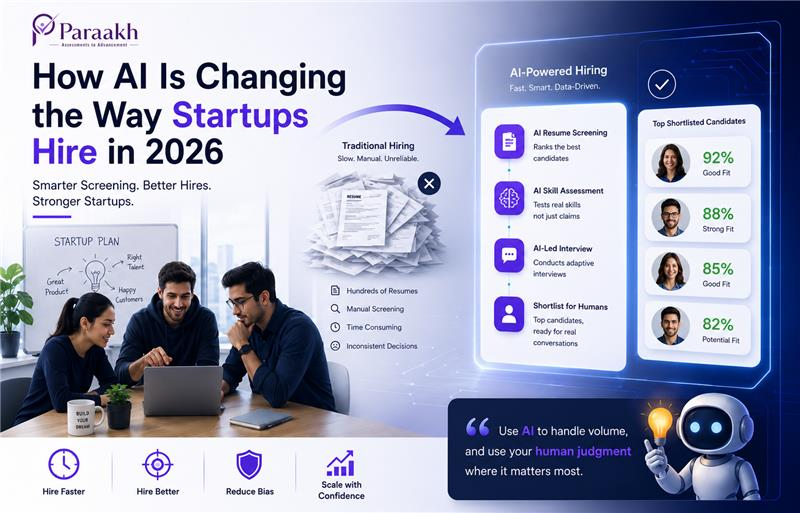
- Candidate applies and gets matched against the role. (AI resume screening)
- A role-specific assessment goes out, built from the actual job description. (AI skill assessment)
- Claimed skills get checked against demonstrated ones. (AI-led interview)
- Qualified candidates move into a shortlist, with interviewers getting a focus brief before the call. (Shortlist for humans)
- The founder conversation happens last, once the baseline is already established.
This is where the tooling matters less as a single feature and more as a connected system. CheckdIn handles the hiring workflow itself intake, matching, pipeline, interview scheduling, and the analytics that show where the funnel is actually leaking. Paraakh sits inside that workflow and does the verification work generating a role-relevant assessment from the JD, comparing claimed skills against proven ones, and handing interviewers a candidate brief instead of a blank resume.
Together, that’s an AI-powered ATS with integrated candidate assessment: one connected path from application to a verified shortlist, instead of a resume pile on one side and a testing tool on the other that nobody’s connected up.
The point isn’t to remove the recruiter or the interviewer from the loop. It’s to stop asking them to re-verify the same candidate three separate times across three separate stages.
The Bottom Line
AI-led screening isn’t about removing people from hiring. It’s about giving small teams the same screening capacity that larger companies get from a full recruiting department, without needing to build that department first.
For startups running lean, that’s not a nice-to-have. It’s increasingly the difference between hiring well and hiring fast and in 2026, the strongest teams are figuring out how to do both at once, using a verified baseline instead of a stack of unread resumes.
Ready to see it on a real role? Run Paraakh and CheckdIn on one active requirement and see what a verified shortlist actually looks like before your next interview round.
FAQ
Is AI hiring reliable for small startup teams? Yes, for screening and shortlisting specifically. It’s not reliable, and isn’t meant to be used, for the final hiring decision or judging culture fit those still need a human conversation.
How is a verified assessment different from a normal skills test? A verified assessment is built from the actual job description and compares what a candidate claims against what they can demonstrate, rather than scoring them against a generic template.
Does using screening tools slow candidates down? It shouldn’t. Assessment fatigue is usually a design problem, not an AI problem short, role-relevant tests tend to see higher completion rates than long generic ones.
Can AI replace interviews entirely? No. Structured first-round interviews can filter for baseline fit, but the final conversation about role fit and motivation still needs a person.
What’s the difference between CheckdIn and Paraakh? CheckdIn manages the hiring workflow: intake, pipeline, interviews, and analytics. Paraakh verifies candidate capability inside that workflow, generating assessments and comparing claimed skills to proven ones.
How much does an AI hiring platform typically cost a small team? It varies widely by provider and pricing model (credit-based vs. per-test), which is worth comparing carefully before committing, since costs can scale unpredictably with hiring volume.