Choosing a tool to assess people can feel harder than choosing the right candidate.
There are dozens of platforms that promise better screening, faster hiring, and smarter decisions. But not every platform is built for the same team. Some focus on hiring tests, some on coding, while others support exams, certifications, or employee development.
So, how do you know what actually fits your needs?
This guide breaks down the main things to look for when comparing skills assessment software and explains how different approaches can support modern hiring and talent development.
What Is Skills Assessment Software?
Skills assessment software helps organizations measure a person’s knowledge, skills, and ability through structured online assessments.
Instead of relying only on a resume or interview, teams can use assessments to collect real evidence of what a candidate or employee can do.
Depending on the platform, assessments may include:
- Multiple-choice questions
- Coding tests
- Open-ended questions
- Voice interviews
- Skill-based evaluations
- Proctored exams
- Role-specific assessments
The right choice depends on what you need to measure and who you are assessing.
Why Are Skills Assessments Important?
A resume can tell you about someone’s experience. It cannot always show whether they can perform the work today.
This is where skills-based assessment becomes useful.
A structured assessment can help teams:
- Compare candidates using the same criteria
- Find skill gaps
- Reduce manual screening
- Support more objective decisions
- Identify candidates who are ready for the role
- Track skills over time
For hiring teams, this can mean less time spent screening and more time spent talking to the right people.
What Should You Look for When Comparing Platforms?
Before choosing a platform, don’t just look at the number of features. Think about your actual workflow.
1. Assessment Creation
Can you create an assessment from a job description, topic, skill, document, or syllabus?
AI-powered question generation can reduce the time needed to build assessments from scratch.
2. Different Assessment Formats
Your team may need more than simple quizzes.
Look for support for formats such as:
- MCQs
- Coding assessments
- Open-ended questions
- Voice interviews
- Proctored exams
- Skill-based evaluations
Having several formats in one workflow can make the platform more useful as your needs grow.
3. Secure Testing
If assessments affect hiring or certification, test integrity matters.
Features such as browser monitoring, violation alerts, live proctoring, and secure assessment environments can help make results more reliable.
4. Automated Evaluation
Manual grading can become difficult when hundreds of people take the same assessment.
AI-assisted grading and automated scoring can help teams review results faster while still allowing human oversight.
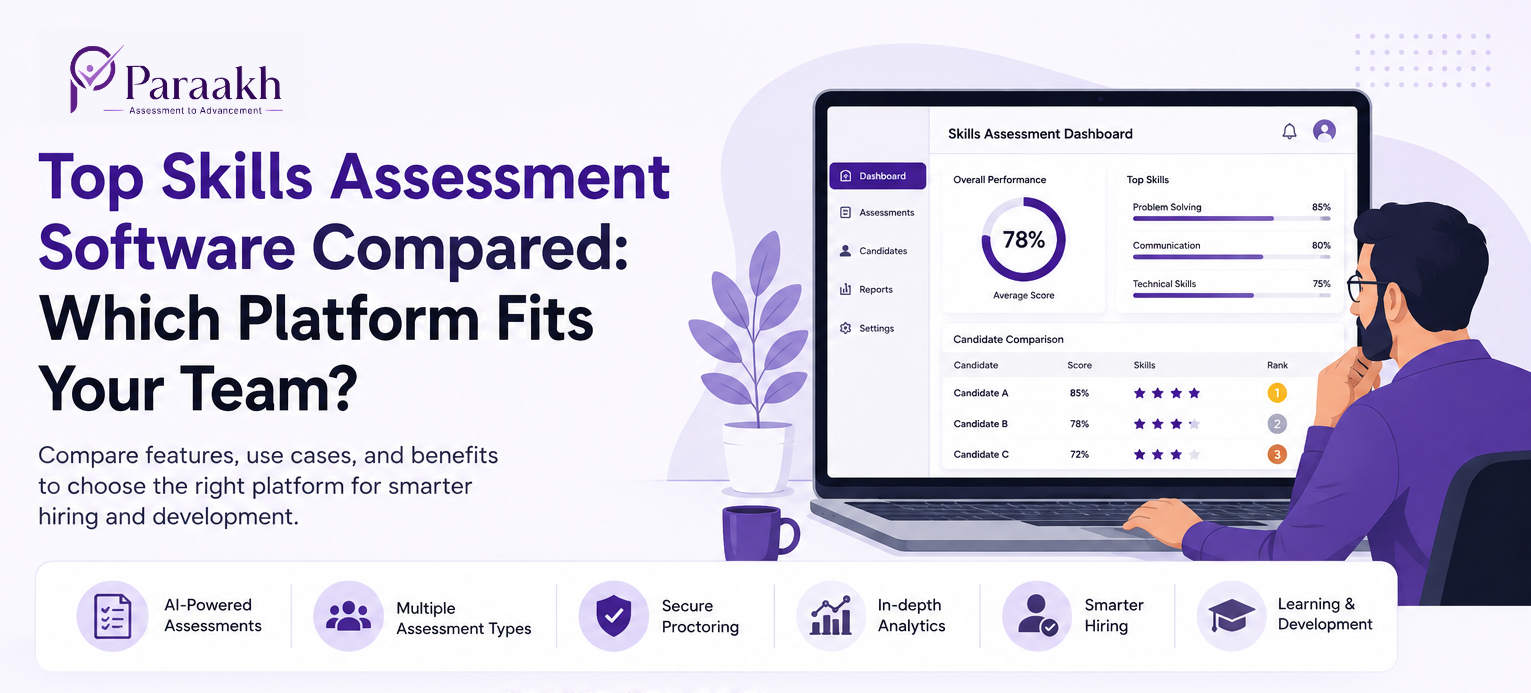
5. Useful Candidate Insights
A good assessment should give you more than a final score.
Look for evidence such as:
- Skill-level scores
- Candidate rankings
- Assessment responses
- Coding results
- Interview transcripts
- Proctoring flags
- Skill gaps
This information helps hiring managers understand why a candidate received a particular result.
A Simple Comparison
Different platforms can be a better fit depending on what your organization wants to achieve.
| Requirement | Basic Testing Tool | Hiring Assessment Platform | Full Talent Assessment Platform |
|---|---|---|---|
| Basic quizzes | ✓ | ✓ | ✓ |
| Role-based assessments | Limited | ✓ | ✓ |
| Coding assessments | Limited | ✓ | ✓ |
| AI question generation | Limited | ✓ | ✓ |
| Voice interviews | — | Some | ✓ |
| Online proctoring | Some | ✓ | ✓ |
| Candidate shortlisting | Limited | ✓ | ✓ |
| Skill tracking | — | Some | ✓ |
| Employee development | — | Limited | ✓ |
| Certifications | Limited | Some | ✓ |
The important point is that more features do not automatically mean a better platform. The best choice is the one that matches your assessment process.
When a Digital Skills Assessment Tool Makes Sense
A digital skills assessment tool can be especially useful when your organization needs to assess people at scale.
For example, a recruitment team hiring 500 candidates for a technical role may not have the time to manually review every applicant.
A structured digital assessment can help filter candidates before interviews.
The same approach can also work for:
- Universities
- Training institutes
- Recruitment agencies
- Corporate learning teams
- Certification providers
- Large hiring teams
The goal is simple: measure skills before making important decisions.
What Makes a Platform More Scalable?
Your assessment needs may change as your organization grows.
Today, you may only need technical tests. Tomorrow, you may need voice interviews, employee skill tracking, certifications, or compliance assessments.
A platform that supports the wider talent lifecycle can reduce the need to manage several disconnected tools.
This is where an integrated approach becomes valuable.
Instead of creating an assessment in one system, interviewing in another, and tracking skills somewhere else, teams can build a connected workflow.
How Paraakh Fits Into the Picture
Paraakh takes a broader approach to talent assessment.
The platform connects hiring, assessment, development, and certification in one workflow. Teams can start with a job description, skill, document, or syllabus and use AI to build assessments.
It supports AI question generation, AI voice interviews, coding assessments, live proctoring, automated grading, candidate shortlisting, and skill tracking.
For hiring teams, this means they can move from assessment creation to candidate evaluation and shortlisting without relying only on resume screening.
The platform also supports different use cases across recruitment, education, training, employee development, and certification.
Questions to Ask Before Choosing a Platform
Before making a decision, ask:
- Does it support the skills we need to measure?
- Can we create assessments quickly?
- Can we customize questions and scoring?
- Does it support coding or practical assessments?
- How does it prevent cheating?
- Can recruiters compare candidates easily?
- Does it provide useful evidence behind scores?
- Can it scale as our team grows?
- Can the same platform support learning or certification later?
These questions can help you avoid choosing a platform based only on a long feature list.
Final Thoughts
The best assessment platform is not necessarily the one with the most features. It is the one that helps your team measure real capability, make better decisions, and manage assessments without adding unnecessary work.
If your organization wants to move beyond resume-based decisions and build a more skills-first approach, Paraakh brings assessments, AI-powered evaluation, proctoring, interviews, coding tests, and skill tracking into one platform.
Ready to see what your team can assess? Explore Paraakh and book a demo to see how the platform can fit your workflow.